Avatar
Research your buyer: interview, observe, and document who they are today
Do I know my ideal customer well enough to describe their fears, language, and decisions — or am I marketing to a spreadsheet?
You don't have an audience problem.
You have a specificity problem.
Your "ideal customer" is a demographic that fits millions of people — and speaks to none of them in particular.
Your avatar is fiction. Built from assumptions and demographics instead of observed behavior and real words.
You project your own head. Assuming your customer thinks about the problem the exact way you do.
It's just age and income. A demographic profile tells you almost nothing about why someone actually buys.
Your copy sounds like you. Written in your language instead of the exact phrases your market actually uses.
From a demographic spreadsheet to their internal monologue
"My 'ideal customer' was a demographic profile — age, income, location — that could describe millions of people and none of them specifically."
"I can describe my ideal customer's fears, aspirations, decision triggers, and the exact phrases they use about their problem. My marketing sounds like them, not like me."
The shift: you don't know your customer until you can write their internal monologue.
You don't just watch lessons.
You leave with 12 real artifacts.
Working documents you actually use — not generic worksheets. By the end they add up to a customer you can describe — fears, language, and all.
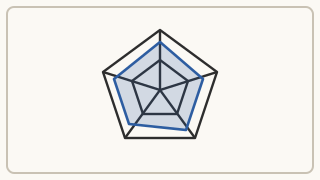
Behavioral Profile Framework
Profile your ideal customer by behavior, not just demographics.
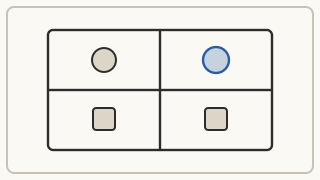
Customer Stratification Model
Sort your audience into clear, meaningful segments.
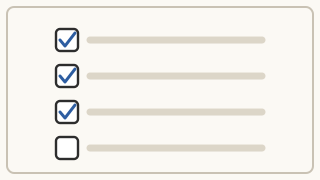
Ideal Customer Selector
Pick the one segment worth building everything around.
Member Profile
Your directory- or niche-specific member profile.
Fear-Desire Spectrum
Map what your customer fears and what they aspire to.
Decision Architecture Map
Chart how they actually make the buying decision.
Credibility Threshold Model
Know the trust they need before they'll commit.
Member Psychology
Your directory- or niche-specific psychology profile.
Language Mining Method
Harvest the exact words your market uses about its problem.
Voice-of-Customer Library
A reusable library of your customer's real phrases.
Language-to-Copy Bridge
Turn their words into copy that sounds like them.
Member Language Guide
Your directory- or niche-specific language guide.
Three moves: who they are → how they think → how they talk
Profile
Who they areDemographics, psychographics, and behavioral patterns of your ideal customer.
- Identify Build the Behavioral Profile Framework
- Segment Apply the Customer Stratification Model
- Prioritize Run the Ideal Customer Selector
- Map Build your directory / niche member profile
Psychology
How they thinkWhat they worry about, aspire to, and use to make decisions.
- Motivate Chart the Fear-Desire Spectrum
- Decide Map the Decision Architecture
- Trust Apply the Credibility Threshold Model
- Decode Decode your directory / niche member psychology
Phrases
How they talkThe exact language they use to describe their problems and desires.
- Harvest Run the Language Mining Method
- Catalog Build the Voice-of-Customer Library
- Deploy Cross the Language-to-Copy Bridge
- Speak Write your directory / niche language guide
More than videos —
a learning system
Every lesson lives in a platform built to help you actually absorb, apply, and return to the work.
AI Chat per lesson
Ask questions and pull key points, action items, and reflections from any lesson.
Searchable transcripts
The full text of every video — search it, scan it, jump straight to the part you need.
Highlights
Mark the passages that matter and filter the transcript down to just your highlights.
Bookmarks
Save the exact moments you'll want to come back to and reopen them in a click.
Notes
Keep personal notes saved right inside each lesson, exactly where you wrote them.
Playlists
Build custom collections of lessons and sequence the path that fits you.
Certificate
Auto-issued the moment you complete every lesson in the course.
Podcast mode
Listen to the course as audio in any podcast app — learn on the move.
Video controls
Closed captions, speed controls, picture-in-picture, and theatre mode — watch your way.
Favorites
Heart any lesson to pin it to your favorites for quick access later.
History & resume
Pick up exactly where you left off — your place is always saved.
Threaded comments
Discuss each lesson with other students in threaded conversations.
Is this course your right next step?
This is for you if…
- Your "ideal customer" is really just a demographic.
- You want to describe one real person, not a broad segment.
- You want to capture the exact words your market uses.
- You want marketing that sounds like them, not like you.
- You want real artifacts — a behavioral profile, a voice-of-customer library — not just content.
This is NOT for you if…
- You're happy targeting "everyone who might benefit."
- You already have a validated, behavior-based avatar.
- You think age and income are enough to market on.
- You'd rather write copy in your own voice than theirs.
Be one of the first to tell your story
These courses are brand new. Once you've done the work, tell us how it changed your thinking — your words could be the first testimonial featured right here.
"Here's how this course changed the way I…"
your story here
"The part that surprised me most was…"
your story here
Three ways to go deeper
This course is one piece of a bigger system. Here's the whole map — and where you are on it.
University
Learn at your own paceThis course — full University access is $80 on its own.
Launchpad
Get the tools to execute-
Ebook$10narrative deep-dive
-
Checklists$15self-assessment diagnostic
-
Journal$20reflective application + AI prompts
-
Workbook$25full execution tracker
One of each — the full toolkit for this course is $70 on its own.
You're buying the University piece — the course, its platform, and the artifacts you produce. Bundle all three and save — see pricing below. Each column is also available à la carte: University $80, Launchpad $70, Events $280. See how we build →
Everything. Course price.
Lock in the full bundle today. Every piece ships to your account as it's built — and the price only goes up from here.
$430 value when complete
Everything, for the price of just the course.
- 12 lessons + AI Chat, transcripts, highlights, bookmarks
- Ebook + Checklists + Journal + Workbook shipping soon
- Workshop + Sprint + Challenge access shipping soon
- Certificate on completion
- Clinics included free — $20 each on their own
The price goes up as content ships — the founding price never comes back.
Not ready to commit? Attend our live workshops, sprints, and challenges for free — just show up. No signup, no credit card. If you like what you experience, the founding price locks in everything permanently.
Every piece below ships to your account as it's built — free, at your founding price:
- Avatar — 12 lessons Digital$80 valueLive now
- Ebook Digital$10 valueIncluded
- Checklists Digital$15 valueIncluded
- Journal + AI Prompts Digital$20 valueIncluded
- Workbook Digital$25 valueIncluded
- Workshop Events$40 valueIncluded
- Sprint Events$80 valueIncluded
- Challenge Events$160 valueIncluded
- Total value when complete$430You pay $80
↑ as the tools ship, the price rises
↑ as the live events go up, it rises again
Full $430 value, fully builtWhat ships when?+
- Week 1: Workshop Part A (courses 1–3) + Ebook ships.
- Week 2: Workshop Part B (courses 4–6) + video lessons go live + Checklists ship.
- Week 3: Sprint recordings + Journal ships.
- Week 4: Challenge recordings + Workbook ships.
Or start bigger — the same deal at every scope:
Course
1 course + tools + events
$80Pod
All 6 Market courses
$320Pillar
All 36 Foundation courses
$960University
All 324 courses
$4,320Same deal at every scope — everything included, price goes up as content ships. See How We Build →
Prefer one piece? Single University, Launchpad, or Events access. · See How We Build →
Founding Access — Avatar
Full bundle (University + Launchpad + Events) · $80 · pre-sale founding rate
[ Simplero checkout / order-form embed renders here ]
Wire this to the Simplero Founding bundle product for this course.
The third step of the Market journey
Avatar is course 3 of 6 in Market. With the real problem in hand, this turns "my audience" into one person you can describe in detail.
You are here — know your customer.
You're not doing this alone
Every lesson has a discussion where you share your work and read how others approached the same prompt — so you see the patterns, not just your own answer.
“Post your experience, read two others, and notice the patterns.”
Per-pillar discussion forums are coming as the community grows.
Before you decide
Isn't a customer avatar just demographics?+
Demographics describe millions and explain nobody's purchase. This builds a behavioral, psychological, language-based profile of one real person.
I already know my audience well.+
Then this sharpens it — most "knowing" is projection. The Fear-Desire Spectrum tests what you assume against what they actually feel.
How do I get their exact language?+
The Language Mining Method harvests real phrases from where your market already talks — reviews, forums, calls, comments.
Do I need existing customers?+
Helpful but not required — you can mine the language and behavior of the market you're entering before you've sold anything.
How much time does it really take?+
Real work across several sessions — profiling behavior, decoding psychology, and mining language. Not a quick read.
What do I actually walk away with?+
12 working artifacts — from a Behavioral Profile Framework and Fear-Desire Spectrum to a Voice-of-Customer Library and Language-to-Copy Bridge.
Do I know my ideal customer well enough to write their fears, language, and decisions — not just their demographics?
Stop marketing to a spreadsheet. Describe one real person — in their own words.